[vc_row row_type=”row” use_row_as_full_screen_section=”no” type=”full_width” angled_section=”no” text_align=”left” background_image_as_pattern=”without_pattern” css_animation=””][vc_column][/vc_column][/vc_row][vc_row row_type=”row” use_row_as_full_screen_section=”no” type=”grid” angled_section=”no” text_align=”left” background_image_as_pattern=”without_pattern” css_animation=””][vc_column][vc_separator type=”normal” color=”#444444″ thickness=”3″][vc_empty_space height=”75px”][vc_column_text]FOR IMMEDIATE RELEASE: August 23, 2017
CONTACTS:
Nicole Budine, Policy and Campaign Manager, Cascade Forest Conservancy, 607-735-3753
Matt Little, Executive Director, Cascade Forest Conservancy, 541-678-2322
Tom Buchele, Managing Attorney, Earthrise Law Center, 503-768-6736
Steve Jones, Board Member, Clark-Skamania Flyfishers, 360-834-1265
Kitty Craig, Washington State Deputy Director, The Wilderness Society, 206-473-2523
Mining Exploration Approved Near Mount St. Helens
Conservation and Recreation Groups Oppose Due to Impacts on Fish, Water Quality and Recreation.
Portland, OR – On August 22, 2017, the Forest Service issued a draft decision consenting to exploratory drilling in the Green River valley, just outside the Mount St. Helens National Volcanic Monument. A coalition of over 20 conservation and recreation groups opposes the project, claiming mining exploration and development will significantly harm wild steelhead populations in the Green River, destroy recreational opportunities in the area, and pollute the water supply of downstream communities. The draft decision begins a 45-day objection period.
“Tens of thousands of people have expressed opposition to this proposal due to its impacts on clean water, native fish, and recreation in and around our most treasured National Monument. Yet the agencies continue to advance this dangerous proposal,” said Matt Little, Executive Director of the Cascade Forest Conservancy. “Allowing mining activities in a pristine river valley alongside an active volcano is simply ludicrous. We will do all we can to stop it.”
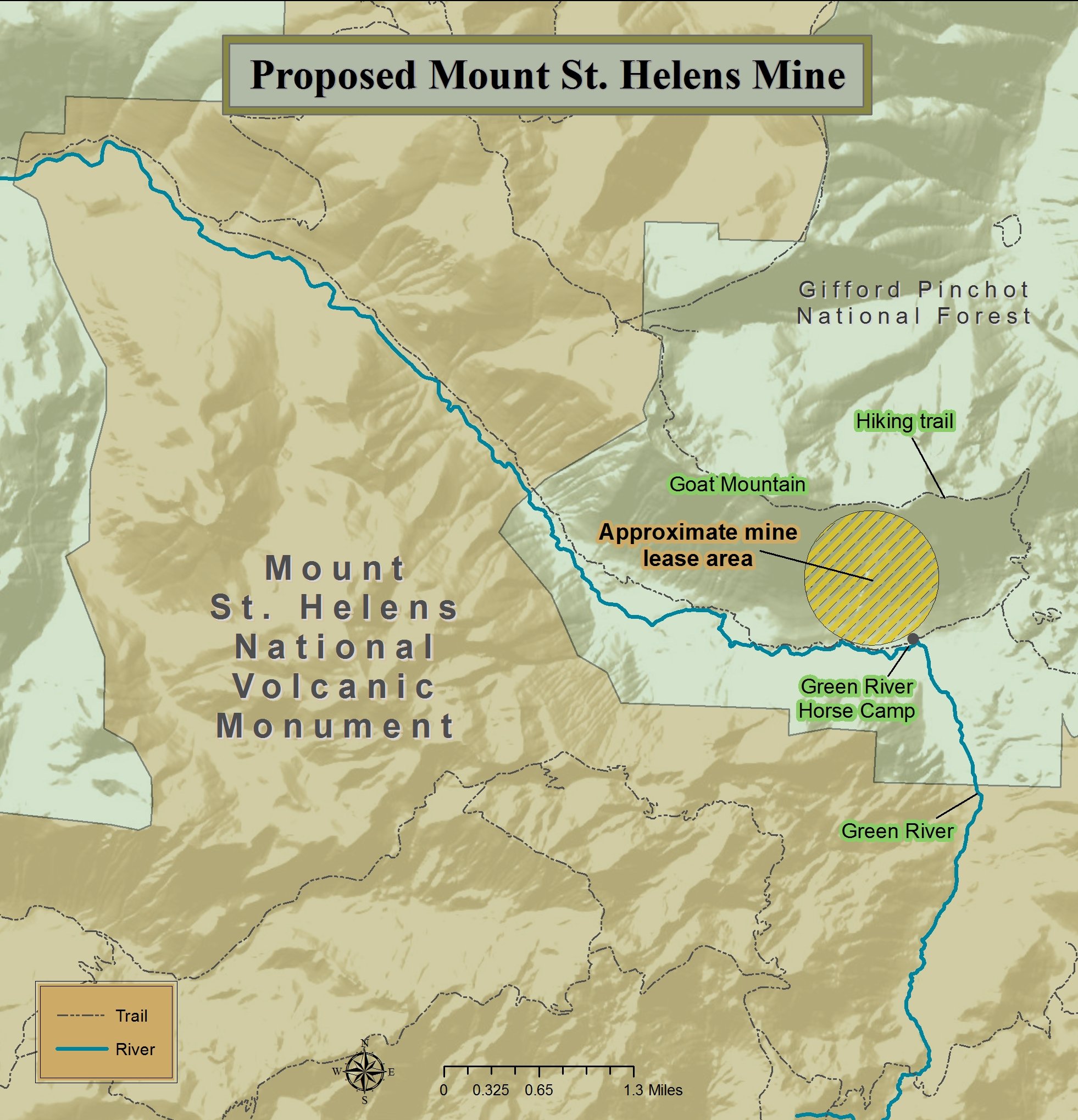
Drilling permits would allow a Canadian mining company, Ascot Resources Ltd., to drill 63 drill holes from 23 drill pads to locate deposits of copper, gold, and molybdenum. The project would include extensive industrial mining operations 24/7 throughout the summer months on roughly 900 acres of public lands in the Green River valley, just outside the northeast border of the Monument. The prospecting permits allow for constant drilling operations, the installation of drilling-related structures and facilities, the reconstruction of 1.69 miles of decommissioned roads, and pumping up to 5,000 gallons of groundwater per day.
Some parcels of land in question were acquired to promote recreation and conservation under the Land and Water Conservation Fund Act (LWCFA). In a previous lawsuit filed by the Cascade Forest Conservancy (then the Gifford Pinchot Task Force), a federal judge invalidated Ascot’s drilling permits and held that the agencies violated the LWCFA by failing to recognize that mining development cannot interfere with the outdoor recreational purposes for which the land was acquired. The decision by the BLM and Forest Service to once again issue Ascot drilling permits follows the release of a modified EA earlier this year, prepared in response to this prior court decision.
“This project would severely impact recreation opportunities due to noise, dust, exhaust fumes, lights, vehicle traffic, the presence of drill equipment, and project area closures,” said Tom Buchele, Managing Attorney of the Earthrise Law Center. “I cannot fathom how the Forest Service could legally conclude that drilling would not interfere with recreation without violating the LWFCA.”
The pristine Green River flows through the Mount St. Helens National Volcanic Monument, passing through old growth as well as a unique post-eruption environment that provides habitat for a variety of native fish and wildlife. The Green River flows into the North Fork Toutle River and Cowlitz River, which provides drinking water to thousands of people in downstream communities. The city of Kelso recently passed a resolution against the mine because of impacts from leaking mine effluent and failed toxic tailings ponds that would result from locating a mine in an active volcanic zone.
“This prospecting is a threat to wild steelhead in the Green River and the rest of the Toutle and Cowlitz River system,” said Steve Jones, Director, Clark-Skamania Flyfishers. “Washington fisheries managers made the upper Green River a Wild Steelhead Gene Bank in 2014 because this habitat offered the best hope for sustaining wild fish in that system. This river drainage needs to be conserved, not exploited.”
“Mount St. Helens National Volcanic Monument is a national treasure that offers a unique recreational and educational experience for visitors in the Pacific Northwest,” said Kitty Craig, Washington State Deputy Director of the Wilderness Society. “Its borders are no place for an industrial mine that will jeopardize the free-flowing Green River, the drinking water of downstream communities, and the wide range of recreational opportunities these lands and waters provide.”
###
PROPOSAL DOCUMENTS:
Modified EA: https://eplanning.blm.gov/epl-front-office/projects/nepa/52147/66795/72638/Goat_Mountain_MEA_20151217_FINAL.pdf
Cascade Forest Conservancy (GPTF) et al modified EA comments: https://cascadeforest.org/wp-content/uploads/2016/07/FINAL-Goat-Mountain-MEA-Comments_2-4-16.pdf
Forest Service FONSI/Draft DN: http://a123.g.akamai.net/7/123/11558/abc123/forestservic.download.akamai.com/11558/www/nepa/101692_FSPLT3_4050107.pdf
Senator Cantwell Letter to the Forest Service: https://cascadeforest.org/wp-content/uploads/2016/09/Cantwell-letter-to-Forest-Service-Goat-Mountain-Project_3-18-16.pdf
LEGAL DOCUMENTS:
Judge Hernandez’s Opinion: https://law.lclark.edu/live/files/17566-gifford-pinchot-mining-decisionpdf.
MAPS/PHOTOS:
Map of the Project Area: https://cascadeforest.org/wp-content/uploads/2016/09/Map-of-Mt-St-Helens-mine-area-zoomed-in.jpg
VIDEO:
Cascade Forest Conservancy “Mount St. Helens: No Place for a Mine” : https://www.youtube.com/watch?v=JjVk78cVNCk
[/vc_column_text][vc_empty_space height=”35px”][vc_row_inner row_type=”row” type=”grid” text_align=”left” css_animation=””][vc_column_inner][vc_gallery interval=”0″ images=”164,161,145″ img_size=”full” onclick=””][/vc_column_inner][/vc_row_inner][vc_empty_space height=”75px”][/vc_column][/vc_row][vc_row row_type=”row” use_row_as_full_screen_section=”yes” type=”grid” angled_section=”no” text_align=”left” background_image_as_pattern=”without_pattern” css_animation=”” css=”.vc_custom_1465592094531{background-color: #96d1ae !important;}”][vc_column][vc_row_inner row_type=”row” type=”grid” text_align=”left” css_animation=””][vc_column_inner][vc_empty_space height=”125px”][latest_post_two number_of_columns=”3″ order_by=”date” order=”ASC” display_featured_images=”yes” number_of_posts=”3″][vc_empty_space height=”75px”][/vc_column_inner][/vc_row_inner][/vc_column][/vc_row]
 Northwest Forest Plan
 Mature forests, well on their way to developing old-growth characteristics, are at-risk in controversial clearcutting projects. Forests that are 80 years or older are often already developing the diversity needed to be valuable habitat and climate refugia. Logging these areas, if done at all, should focus on the development of old-growth characteristics. Commercial logging should focus on thinning plantations to improve diversity, as plantations offer little value for either habitat or carbon storage. Management of forests should look beyond their financial value for timber production and also consider their immense value in mitigating the costly impacts of climate change.



 As is the case with any modeling process, climate projections can vary. There are, however, many areas of agreement among the various climate models and these projections offer a warning for those of us hoping to protect our natural resources. The projections also highlight opportunities to protect habitat and wildlife. Some aspects of our local ecosystem will likely not fare well under changing conditions, yet others are expected to do fine. For many species and habitat types, there are conservation and restoration steps that we can take to mitigate harm and help them persist.
 throughout the western United States; further increases, up to 2- to 4-fold, are expected in the coming century. Higher temperatures will cause streams to warm and will threaten a variety of aquatic species, especially salmon and bull trout.
 Connectivity represents the critical arteries sustaining the ecosystem. Robust connectivity throughout the landscape makes wildlife populations more resilient to climate impacts by allowing movement to alternate habitat areas and decreasing the degree to which disturbance in a particular habitat patch affects the overall viability of the population. As forest ecosystems move due to climate change, oftentimes shifting to higher elevations and northward, this forces species migrations and population shifts. These changes will be exacerbated and sometimes caused by local disturbances like wildlife or drought, and by the decoupling of species relationships. For example, as certain wetland vegetation disappears, the bird and insect species that depend on them also suffer and become scattered in distant patches. We must provide room to allow species and population movements to occur and not be hindered by geographic bottlenecks.