Lamprey have remained largely unchanged for 360 million years, but today, their populations have been severely impacted by dams and habitat loss. For the past several years, Cascade Forest Conservancy has worked to incorporate lamprey habitat needs into restoration planning wherever lamprey may be present.
Meet the Pacific lamprey: An Ancient Species at Risk
Adult Pacific lamprey have long, eel-like bodies and flexible, cartilage skeletons, and a number of unique features that set them apart from species that evolved more recently. Instead of gill slits, lamprey have rows of seven gill pores on each side of their heads. They have a single nostril (located on top of their head), lack paired fins, and perhaps most notably, adults possess disk-shaped and tooth-filled mouths they use to suction onto prey and even climb waterfalls as they travel upstream to spawn.
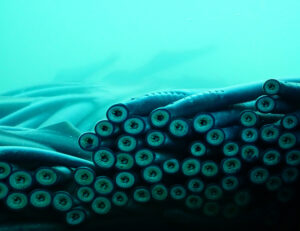
Pacific lamprey are a culturally significant species for Indigenous communities and contribute to the health of aquatic ecosystems, but today, populations of these ancient survivors are in serious decline due to the impacts of impassable dams, predation by non-native fish, and habitat loss.
Restoring aquatic habitat with lamprey in mind
Like salmon and steelhead, Pacific lamprey are anadromous, migrating as adults from saltwater to spawn in freshwater streams. They all share many habitat needs, including gravel-bottomed streambeds for spawning, access to side channels and off-channel habitats, and pools for refugia. However, while both species benefit from healthy, complex stream ecosystems, their habitat needs differ at certain stages of their life cycles.
Once Pacific lamprey hatch and develop into larvae, they depend on a very specific type of habitat for much of their lives. Larval lamprey move downstream and burrow into areas of fine sediment, where they can spend up to 10 years or more filter-feeding on algae, diatoms, and organic material, serving a key ecological role filter feeding beneath fine stream sediments.
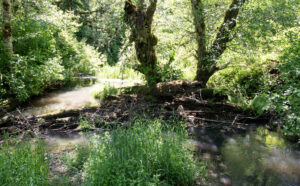
These habitats are typically found along stream margins, in pools, and in other slow-moving areas where fine sediments accumulate. In addition to fine sediments and organic material, larval lamprey also need adequate dissolved oxygen and suitable water velocities.
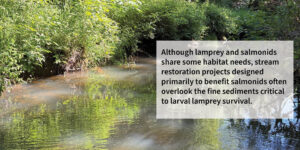
Although lamprey and salmonids share some habitat needs, stream restoration projects designed primarily to benefit salmonids often overlook the fine sediments critical to larval lamprey survival.
Because larval lamprey remain buried in sediment year-round, activities that disturb these areas can affect them at any time. Multiple age classes of lamprey may also occupy the same sediment patch, meaning a single disturbance can affect several generations.
Lamprey surveys at Salmon Creek
For the past several years, Cascade Forest Conservancy has worked to incorporate lamprey habitat needs into restoration planning wherever lamprey may be present. One example is our work on Salmon Creek, a tributary of the Cowlitz River. Previous observations of Pacific and Western lamprey throughout much of the watershed indicated that our restoration sites along the mainstem and tributaries could be providing habitat for lamprey.
The Pacific Lamprey Habitat Restoration Guide emphasizes the importance of understanding whether lamprey are present at a restoration site, which life stages use the habitat, and when and how they use it. With that guidance in mind, we conducted larval lamprey surveys across three project reaches of Salmon Creek in June and July before beginning restoration work. We used electrofishing and a modified sediment-sampling method developed by Lasne et al. (2010) to better understand where larval lamprey were present.
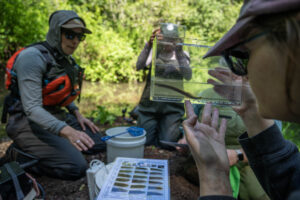
We found larval lamprey in two of the three surveyed reaches, with habitat and abundance changing substantially as we moved upstream. In just 10 minutes of electrofishing at one upstream sediment patch, we found approximately 30 larval lamprey! Based on the available habitat size, we estimated the area likely supported hundreds of larvae across different age classes.
These findings directly influenced our restoration plans. Because we found so many larval lamprey in the upper reach, we removed part of that area from our project design to avoid disturbing occupied sediment and potentially harming the population.
Our work at Salmon Creek shows why surveying for lamprey before restoration matters. Projects designed to improve habitat for salmonids can also benefit lamprey, but without understanding where larvae are present, restoration activities can unintentionally disturb the habitat they depend on. By incorporating lamprey surveys into our planning, we can make more informed decisions that benefit a broader range of native fish species.
Thanks to Monica Blanchard at WDFW for electrofishing at our project sites, to the volunteers who dug around in the creek, and to the Pacific Lamprey Conservation Initiative for supporting the work to protect lamprey!