Executive Director’s Note:
It’s common sense: good public land management involves robust public input.
When the voices of the people who know, love, and care for our public lands are heard, stewardship actions achieve better outcomes for everyone. But when decision-makers ignore the knowledge held by local communities, actions impacting public lands can cause unnecessary ecological harm or become bogged down in expensive, time-consuming litigation.
Cascade Forest Conservancy and our partners are committed to preserving your right to have a say in what happens to your public lands. We think it’s common sense. Unfortunately, the D.C. officials working to reverse the Roadless Conservation Rule don’t appear to share our conviction. Before the Rule was put into place 25 years ago, the US Forest Service held more than 600 public meetings. Shockingly, the process to repeal it may not include a single one. The Cascade Forest Conservancy and our partners will not let that happen.
This is not how these processes are meant to work when the changes being considered are of this scope and magnitude. The future of the Roadless Rule will have a major impact on landscapes, wildlife, and communities across the Pacific Northwest and beyond. Excluding the Wilderness Act, no other rule or piece of legislation protects a greater amount of large intact wildlife habitat and backcountry from mining, logging, and other forms of development by limiting road building and timber harvest to limited circumstances.
The wild places protected by the Roadless Area Conservation Rule belong to all of us. We have a right to participate in discussions about how our public lands are used, and those managing them have a responsibility to seek our input. So if today’s Forest Service leadership won’t do its job, then we’ll do it for them.
In fact, we’ve already started. Now you can help too.
A coalition of national and local conservationists has organized public meetings across the Pacific Northwest and beyond.
Join us to speak for national forests.
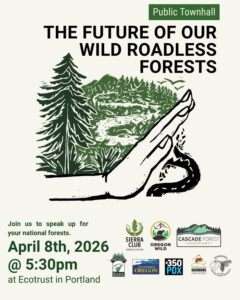
In Portland, Oregon:
April 8th, 5:30-8:00 pm Ecotrust Building
(721 NW 9th Ave, Portland, OR 97209)
In Seattle, Washington:
April 17th. Details coming soon.
NEWS & UPDATES:
CFC Has Nominated the Upper Lewis River for Outstanding Resource Waters Status
|
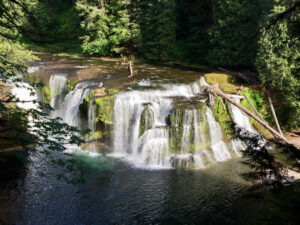
Cascade Forest Conservancy, along with a coalition of conservation and recreation groups, has nominated the Upper Lewis River and three other waterways for Outstanding Resource Waters (ORW), a designation made by states that protects high-quality waterways from future degradation under the Clean Water Act. These types of state designations are particularly important these days, as they can help protect against rollbacks at the federal level, such as the rollback of the roadless conservation rule discussed above. |
|
Why nominate the Upper Lewis River for Outstanding Resource Waters Status? |
|
The watershed we nominated contains beautiful and high quality waterways that serve as valuable habitat for coho, steelhead, bull trout, and other species. This area is also a popular recreation destination for its scenic beauty, fishing opportunities, whitewater opportunities, hiking trails, and renowned waterfalls. The nominated area lies entirely within the Gifford Pinchot National Forest. Significant portions flow through designated Wilderness Areas, Inventoried Roadless Areas, and Late-Successional Reserves (parcels of national forests where the primary management objective is the protection and enhancement of mature and old-growth forest habitats). Protecting the Upper Lewis River will have positive impacts beyond the areas included in our nomination. The EPA has identified this river as one of 12 primary thermal refugia in the Columbia River. This means that the cold waters flowing from the area we aim to protect play a major role in maintaining water conditions that support the survival of temperature-sensitive species throughout the lower Columbia basin. |
|
What’s next? |
|
Washington’s Department of Ecology is now reviewing our proposal. In the coming months, the agency will issue a determination on whether the Upper Lewis River meets one of the criteria for Outstanding Resource Water. We are optimistic that Ecology will recognize the pristine character, unique recreational value, and ecological significance of this beautiful stretch of the Upper Lewis River and determine that it meets at least one ORW criteria. If they do, the agency will begin a robust public process involving public outreach, consulting with tribes and local governments, and a formal rule making process. Our first ORW nomination resulted in a historic win, as sections of the Green River and three other waterways became Washington state’s first ever Outstanding Resource Waters in 2023. A strong showing of public support for the new protections was key to our success. We’ll keep you updated about developments and share upcoming ways you can help us protect the Upper Lewis River
|
Volunteers made a difference this March!
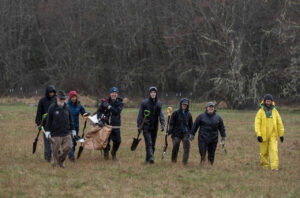
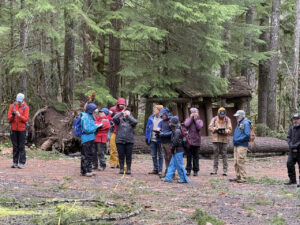
This month, a group of volunteers braved wet and rainy conditions to plant 250 trees along a stretch of Hall Creek, a tributary of the Cowlitz River. As they grow, the conifers and willows we planted will cool water temperatures and stabilize the streambanks—supporting salmon and other aquatic species.
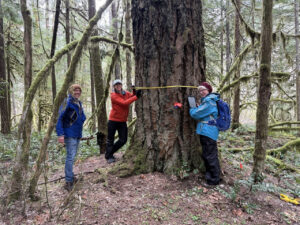
The following weekend, 39(!!) volunteers joined us in the field to protect old-growth Douglas fir around Gifford Pinchot National Forest.
On Friday, we worked alongside the Forest Service to install MCH pheromone caps on trees in Iron Creek Campground. On Saturday, volunteers and Government Mineral Springs Cabin Association members placed MCH caps on trees around Trapper Creek and the historic Government Mineral Springs guard station. Finally, on Sunday, we inventoried trees at Panther Creek Campground and installed MCH caps on recently downed trees. The data we collected will help inform future protection efforts.
Thanks to everyone who came out to lend a hand!
Together, we planted hundreds of trees; installed over 500 MCH pheromone caps on 80 individual trees across three old-growth sites; and collected data on 151 trees.
UPCOMMING EVENTS:
Volunteer Opportunity:
Planting for Pollinators at Mt. Adams
Thursday, April 9
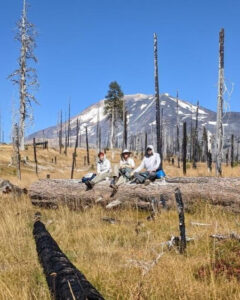
Help us create habitat for pollinators near Mt. Adams! Insect pollinators, such as bees, moths, and butterflies, survive on nectar and pollen collected from wildflowers and shrubs. Healthy plant communities support healthy pollinator communities and vice versa. For several years, CFC has been working with the Forest Service to improve plant and pollinator communities in an area that has experienced several wildfires in recent years in short succession.
We need your help to plant native seedlings. Our efforts will help plant communities recover more quickly in the burned area and provide more support for pollinators.
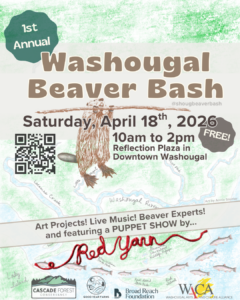
Save the Date: Washougal Beaver Bash is Coming April 18!
|
|
Get ready to celebrate International Beaver Day in Washougal! The Washougal Beaver Bash will be a free, family-friendly event featuring art projects, live music, and exhibitor booths with beaver experts ready to share knowledge about our favorite ecosystem engineers! |
The UNDERSTORY NW FILM FEST
Thursday, May 28
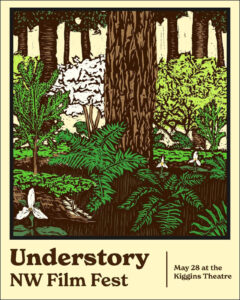
Mark your calendars for the return of our annual UNDERSTORY NW FILM FEST, a night of stories celebrating conservation and our connections to the world around us at Vancouver’s Historic Kiggins Theatre.
Details, trailer, and tickets coming soon!